| |
|
| |
|
|
|
|
|
|
| |
 |
![Rothko a Firenze, exhibition view, Palazzo Strozzi, Firenze, 2026 [Photo Ela Bialkowska, OKNO Studio]](https://lh3.googleusercontent.com/pw/AP1GczMFvHzFYMhsU5gvMf5KFKO_UeuAUhQ8euYgAk0QvkOdggytOdBjj6RVKkSTUzLPA-ZU92u-aGUmVjNYivbgWPszqFtyUufWUzJP0UjNHxYyxstXJwEY=w1600-h1600-p-k)
|
|
Rothko a Firenze, exhibition view wit Mark Rothko Untitled, 1952–53 and No. 13 [White, Red on Yellow], 1958, Palazzo Strozzi, Firenze, 2026 [1]
|
|
 |
 |
| |
|
|
|
| |
|
Mark Rothko in Florence. Palazzo Strozzi, Florence
14 March to 23 August 2026
From 14 March to 23 August 2026, Palazzo Strozzi is hosting a major retrospective of Mark Rothko’s work, featuring over seventy pieces. The project also involves the Museum of San Marco and the Laurentian Library, creating a dialogue with Beato Angelico and Michelangelo.
|
|
|
|
| |
|
Following anthological exhibitions dedicated to Ai Weiwei, Bill Viola, Anselm Kiefer, Anish Kapoor, Marina Abramovic and Helen Frankenthaler, Palazzo Strozzi continues its exploration of modern and contemporary art with an icon of 20th-century American painting. From March 14 to July 26, 2026, the Fondazione Palazzo Strozzi in Florence is dedicating one of the largest retrospectives ever organized in Italy on the master of American modern art to Mark Rothko (1903-1970).
Curated by Christopher Rothko and Elena Geuna, the exhibition will investigate the influence of Renaissance art on the artist’s vision. His relationship with Florence dates back to 1950, when he visited Italy with his wife Mell-a trip that signified for him the beginning of a strong attraction to the masters of the 14th, 15th and 16th centuries.
The exhibition will propose a new itinerary with the intention of highlighting the deep connection between Rothko and Florence, which will be developed not only in the rooms of Palazzo Strozzi, but also in two symbolic places of the Renaissance: the Museum of San Marco, in dialogue with Beato Angelico’s frescoes, and the vestibule of the Biblioteca Medicea Laurenziana, designed by Michelangelo.
The exhibition project will present a wide selection of Rothko’s works, from the 1930s to 1970, with numerous large-format paintings, many of which have never before been exhibited in Italy. The loans come from the artist’s family, private collections and major international museums.
|
 |
Mark Rothko, 1952-1953 circa. Photo Henry Elkan/Courtesy The Rothko Family Archive [0]
|
The exhibition at Palazzo Strozzi retraces Rothko’s entire career with over 70 works from major international museums and prestigious private collections, including The Museum of Modern Art (MoMA) and The Metropolitan Museum of Art in New York, Tate in London, Centre national d’art et de culture Georges-Pompidou in Paris, and the National Gallery of Art in Washington D.C.
|
![Rothko a Firenze, exhibition view, Palazzo Strozzi, Firenze, 2026 [Photo Ela Bialkowska, OKNO Studio]](https://lh3.googleusercontent.com/pw/AP1GczMktesKBc3ndIpxcKk4cYCGfrjFZQ4H4UN8Orjq0giLyDUPu1fBwiwXip3dkT2o1uZN_De_HoxdX0qoTqyIV49p9J8V8gfW2AzR8tyispzRE_bUa0IF=w9504-h5346-p-k) |
Rothko a Firenze, exhibition view Palazzo Strozzi, third Room, Firenze, 2026 [1]
|
From Palazzo Strozzi, the project extends into the city through two special satellite interventions at locations particularly significant to the artist: the Museum van San Marco, where a selection of works will be presented in dialogue with the frescoes of Fra Angelico, and the Vestibule of the Biblioteca Medicea Laurenziana designed by Michelangelo[4].
Rothko and his journey to Italy
It was his travels to Italy around 1950 that proved pivotal to his artistic maturity; the study of colour in Venetian painting, the classical heritage of Rome and Pompeii and, in particular, the visual plasticity he absorbed from seeing Beato Angelico’s works in Florence and Michelangelo’s architecture in the Vestibule of the Laurentian Library were key elements in transforming pictorial abstraction from a purely formal discourse into an experiential process designed to elevate consciousness: for Mark Rothko, the experience of art is a fundamental aspect, as pure as the creative moment itself.
|
 |
Rothko in Florence, exhibition in Palazzo Strozzi, Museum of San Marco and the Laurentian Library, Florence, 2026 [1]
|
Rothko in Florence
Palazzo Strozzi, Florence
14 March – 23 August 2026
www.palazzostrozzi.org
The exhibition is organised by the Fondazione Palazzo Strozzi in collaboration with the Museum of San Marco and the Laurentian Library, both institutions of the Italian Ministry of Culture.
The project brings together works from major international museums including the Museum of Modern Art and the Metropolitan Museum of Art in New York, the Tate in London, the Centre Pompidou in Paris and the National Gallery of Art in Washington.
|
|
|
|
| |
|
Mark Rothko: The Silence of Color
by Elena Geuna
|
![Rothko a Firenze, exhibition view, Room 4, Palazzo Strozzi, Firenze, 2026 [Photo Ela Bialkowska, OKNO Studio]](https://lh3.googleusercontent.com/pw/AP1GczMT5XlJpiwMIa_Hqeam6_DrhpZ8RUSlzQ9zgLn8fMEKSacvSgxmTOwh-OfOWQiv653jQDJHMgoaBXRisaBCwMTJyA-tZsYBOkiSjBAzl0ynn98FyKHo=w2400-h1350-p-k) |
Rothko a Firenze, exhibition view, Room 4, Palazzo Strozzi, Firenze, 2026 [Photo Ela Bialkowska, OKNO Studio] [1]
|
Florence is a city built on the belief that the visible can lead us toward the invisible. Nowhere else is the boundary between the material and the spiritual so deliberately thinned, by the gold of an altarpiece or the hush of light on plastered walls. In the early Renaissance, artists and thinkers here believed that geometry was a pathway to grace, that proportion might reflect a divine order, and that the placement of color on a wall could alter the soul of the one who beheld it. Without separating the rational from the spiritual, beauty itself became a form of metaphysical knowledge shaped through harmony, expressed in proportion and color. Transcendence, in the Florentine sense, was found in the careful articulation of the world, in forms of expression that were anchored to physical space while pointing beyond it.[2]
|
![Rothko a Firenze, exhibition view, Palazzo Strozzi, Firenze, 2026 [Photo Ela Bialkowska, OKNO Studio]](https://lh3.googleusercontent.com/pw/AP1GczOpFlw2TeMouA671mRw2LmhqP3S00kwjEgdh15fWtjgyhJXHZXzJSmdXytKknats4UpS2luikfkquh2IznKtSfd7zl-QJukiSPSsrfAIJwk6GYRdctP=w1393-h933-p-k) |
| Rothko a Firenze, exhibition view, Palazzo Strozzi, Firenze, 2026 [Photo Ela Bialkowska, OKNO Studio] [1] |
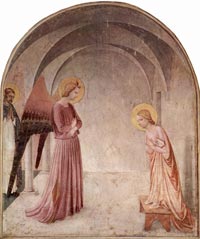
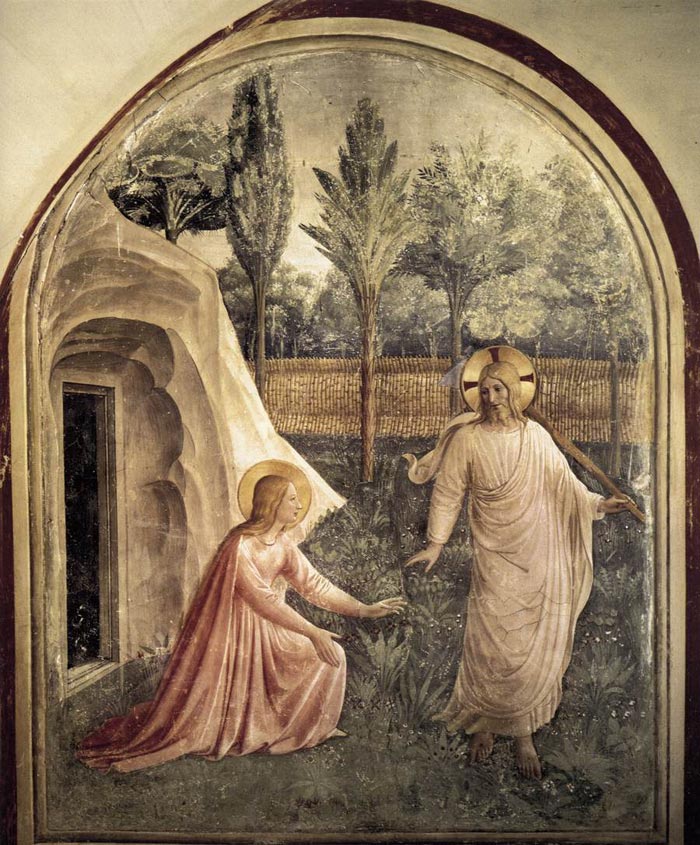
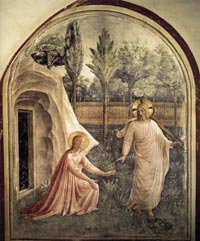
Few works embody this vision more fully than the frescoes of Fra Angelico, painted between 1439 and 1444 for the cells of the Observant Dominican monastery of San Marco. His frescoes, whether a Visitation, or a Crucifixion, were conceived to open a contemplative space where silence and color could communicate a truth beyond words. In the stillness of the monastic cells, the frescoes vibrate with ethereal hues of blue, rose, and ocher, hovering at the boundary where the image becomes inseparable from the act of inward contemplation. It was to these rooms that Mark Rothko came more than five centuries later, during his first visit to Italy in the spring of 1950. We can almost picture him, ambling through the halls of the Museum of San Marco, alone in the soft Florentine light, stopping in front of each of Fra Angelico’s frescoes as well as his altarpieces. Before those radiant yet pared-down scenes emptied of spectacle, suffused with tonal restraint, he would have recognized an artistic logic remarkably aligned with his own, where meaning unfolds only through the patience of looking. From the Museum of San Marco, he made his way to the Laurentian Library, where Michelangelo’s staircase presses inward and upward, as though space itself were contemplating its own form. In its grandeur and calculated disquiet, the architecture offers a drama of form that Rothko, ever attentive to the emotional valence of proportion and weight, would not have missed. Years later, Rothko would recognize in Michelangelo’s architecture a theater of space and gravity, and would recall the Laurentian Library as formative, citing it directly when reflecting on a series of murals he had begun for the Four Seasons restaurant in New York, part of a commission for the Seagram Building. Though he would ultimately withdraw from the Seagram commission, the paintings carry the architectural imprint of that Florentine encounter. Rothko had been struck by the vestibule’s blocked windows and heavy stillness, which, to him, expressed a very particular kind of emotional intensity, charged with an unresolved innermost pressure. “He achieved just the kind of feeling I’m after,” Rothko remarked of Michelangelo. “He makes the viewers feel that they are trapped in a room where all the doors and windows are bricked up, so that all they can do is butt their heads forever against the wall.” It is no coincidence that Florence provides the setting for this exhibition.
For Rothko, Florence was an encounter with a visual language that mirrored his own longings. If Fra Angelico’s frescoes offered a model of contemplative openness, then the Laurentian Library presented an embodiment of the existential weight Rothko would later pursue in the darker, more enclosed canvases of the 1960s. The city’s chromatic restraint and its capacity to stage the visible as a threshold to the invisible resonated deeply with his own evolving vision. In Florence, and its Masters, the artist was able to recognize an architecture of silence that would come to define his own painterly language.[2]
|
Mark Rothko in previous exhibitions at Palazzo Strozzi
|
![Helen Frankenthaler, Dipingere senza regole, Palazzo Strozzi, Firenze, veduta della sale 4, con Mark Rothko, Untitled (Senza titolo), 1949 [© Photo Ela Bialkowska OKNOstudio]](https://lh3.googleusercontent.com/pw/AP1GczNKRxOrbNKYG3g8z7niANhyPBTaUw9PYArp8GHr6B6-TfpCYWEK2Q7p0OtsWUHmWtM2N7TF-b4542UGysorxXBR9wDe34ZSh6pZ_2QuFLOhuNAxRGvC=w2508-h3762-p-k) |
Helen Frankenthaler, Dipingere senza regole, Palazzo Strozzi, Firenze, veduta della sale 4,
con Mark Rothko, Untitled (Senza titolo), 1949 [1] |
![American Art 1961-2001, Palazzo Strozzi, Firenze. Veduta delle sale, con Louise Nevelson, Sky Cathedral Presence, 1951-1964, e Mark Rothko, No. 2, 1963 [© photo Ela Bialkowska OKNO Studio]](https://lh3.googleusercontent.com/pw/AP1GczOks9747K66J6bxHppD6vHPxgapEwrD-N-mkX9GTzpbwhprUBhFgv0gGYO0VNcKec942ZFIUGmIvfwgB-20HHhEHGl__gPO5Brl1h_JbPIBwT0PAelb=w800-h920-p-k) |
Mark Rothko , No. 2, 1963, Minneapolis, Walker Art Center. Dono Mark Rothko Foundation, Inc. 1985
© 1998 Kate Rothko Prizel & Christopher Rothko / ARS, New York [American Art 1961-2001, Palazzo Strozzi, Firenze] [1]
|
| |
|
|
| |
|
Mark Rothko and Fra Angelico
Throughout his life, Rothko engaged with philosophical, aesthetic and historiographical issues, constantly redefining and questioning his own position as an artist. His ideas reveal his involvement with and research into early Italian painting, particularly that of Giotto di Bondone (1264–1337) and Fra Angelico. His numerous trips to Italy allowed him to admire the works of Giotto and Beate Angelico in situ.
During his first trip to Europe in 1950, Mark Rothko found deep inspiration in Fra Angelico's frescoes in the monastery of San Marco in Florence. Fra Angelico's ecclesiastical commissions, painted in the fifteenth century, were also expressions of his faith and devotion. Rothko was impressed by the subtle way in which the artist used light and colour, and how his frescoes invited contemplative viewing.
For Rothko, the frescoes reflected what Hegel described as the invention of “artistic interiority”. This experience offered Rothko a gateway to emotional transcendence, which formed the impetus for his own work. It was the meditative and inner atmosphere in the frescoes of San Marco that Rothko hoped to evoke himself, and with which he defined his artistic conception of space: Rothko imagined chapel-like spaces ‘in which the traveller or traveller could contemplate one detail of a painting in a small room’.
Throughout his life, Rothko insisted that he was not an abstract painter. He controlled the hanging of his works and called his paintings “murals”, analogous to the Italian technique of fresco painting.
In 1957, he wrote, ‘I am interested only in expressing the basic human emotions - tragedy, ecstasy, doom, and so on [...]. The people who weep before my pictures are having the same religious experience I had when I painted them.’[5]
|
Palazzo Strozzi, Florence
|
|
|
|
|
 |
|
 |
|
 |
Palazzo Strozzi, Firenze
|
|
Museo di San Marco, veduta posteriore
|
|
Beato Angelico, la grande mostra a Palazzo Strozzi, Firenze
|
|
|
 |
|
 |
Fra Angelico, Annunciation
|
|
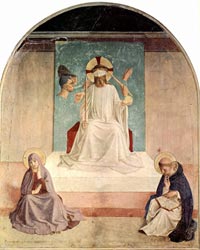
Fra Angelico, The Mocking of Christ
(cell 7) |
|
Fra Angelico, Noli Me Tangere, 1440-41, fresco, 180 x 146 cm, Convento di San Marco, Florence
|
Exhibitions Palazzo Strozzi, a selection
Angelico, Fondazione Palazzo Strozzi, Firenze, 26 September 2025 - 25 January 2026
Tracey Emin. Sex and Solitude, Palazzo Strozzi, Firenze, 16 March 2025 - 20 July 2025
Helen Frankenthaler, Dipingere senza regole. Palazzo Strozzi, Firenze, 27 September 2024 - 26 January 2025
American Art 1961-2001, The Walker Art Center Collections, from Andy Warhol to Kara Walker, Fondazione Palazzo Strozzi, 28 May 2021 - 29 August 2021
The exhibition brings together an outstanding selection of more than 80 works by 53 artists including Andy Warhol, Mark Rothko, Louise Nevelson, Roy Lichtenstein, Claes Oldenburg, Bruce Nauman, Barbara Kruger, Robert Mapplethorpe, Cindy Sherman, Matthew Barney, Kara Walker and many more.
|
|

|
|
|
 |
|
![Olafur Eliasson, Solar compression, 2016. Fondazione Palazzo Strozzi, Florence – 2022
[Photo: Ela Bialkowska, OKNO Studio. Courtesy Fondazione Palazzo Strozzi, Florence]](https://lh3.googleusercontent.com/pw/AP1GczM-YUTyoOj-8v6Ymvgp48K56esxlziY9qY2lLLJwYSd5J6GJdbc2Gch38PIaP_269UzVt1qBMghoalE5PP4ow8dAzi_4A24uMLAUqUiGp7-WQ5Kj08l=w700-h467-p-k) |
|
 |
Helen Frankenthaler, Dipingere senza regole. Palazzo Strozzi, Firenze
|
|
Olafur Eliasson, Solar compression, 2016. Fondazione Palazzo Strozzi, Firenze – 2022
|
|
Marina Abramovic, The Cleaner, Palazzo Strozzi, 2018
|
![American Art 1961-2001, Palazzo Strozzi, Firenze. Veduta delle sale Crossing Boundaries, con un focus su Merce Cunningham, John Cage, Robert Rauschenberg e Jasper Johns [© photo Ela Bialkowska OKNO Studio]](https://lh3.googleusercontent.com/pw/AP1GczMftAJ6JpW5rn0E9Em3nxB9XufdX4rWnk0O49MlEO0KhWUH8XgI9M-pVNj5VHp_s0WNtB3l9Seg0xRtR9uhUYgflohU4x_FJGiGugdt6q8iaUabit9d=w1000-h600-p-k) |
|
![American Art 1961-2001, Palazzo Strozzi, Firenze. Veduta delle sale, con Louise Nevelson, Sky Cathedral Presence, 1951-1964, e Mark Rothko, No. 2, 1963 [© photo Ela Bialkowska OKNO Studio]](https://lh3.googleusercontent.com/pw/AP1GczM8mzVNGUql4Mo-Mr-N2tgoO1YUz0JfmBg4ehUeuqy_lWkfCcAsYiQwEWolH4hcXTFgGm5JU30d0PUjod9RFQzxMACBY4bK5CB5UJhS55w3bvtGuhK6=w900-h601-p-k) |
|
![American Art 1961-2001, Palazzo Strozzi, Firenze. Veduta delle sale Crossing Boundaries, con un focus su Merce Cunningham, John Cage, Robert Rauschenberg e Jasper Johns [© photo Ela Bialkowska OKNO Studio]](https://lh3.googleusercontent.com/pw/AP1GczNhbON3r_3P9VV_EW8vHO0x6kZP-NQbHh13xoNGmBkh9TTCkHeN9xPCgcj-Rv-ejj-c5u2-fVcxBnArK4GiIJOqkiSRn2go_RvYld5FGIU40NZ4k1fQ=w600-h560-p-k) |
American Art 1961-2001, Palazzo Strozzi, Firenze. Veduta delle sale, Crossing Boundaries, con un focus su Merce Cunningham, John Cage, Robert Rauschenberg e Jasper Johns
|
|
American Art 1961-2001, Palazzo Strozzi, Firenze. Veduta delle sale, con Louise Nevelson, Sky Cathedral Presence, 1951-1964, e Mark Rothko, No. 2, 1963
|
|
American Art 1961-2001, Palazzo Strozzi, Firenze. Veduta delle sale Crossing Boundaries, con un focus su Merce Cunningham, John Cage, Robert Rauschenberg e Jasper Johns
|
| |
|
|
|
|
| |
|
|
|
|

|

Artists in residence
Trova la casa perfetta per la tua vacanza | Tuscan Holiday houses | Podere Santa Pia
|
|
|
 |
|
 |
Celebrare il dolce far niente
|
|
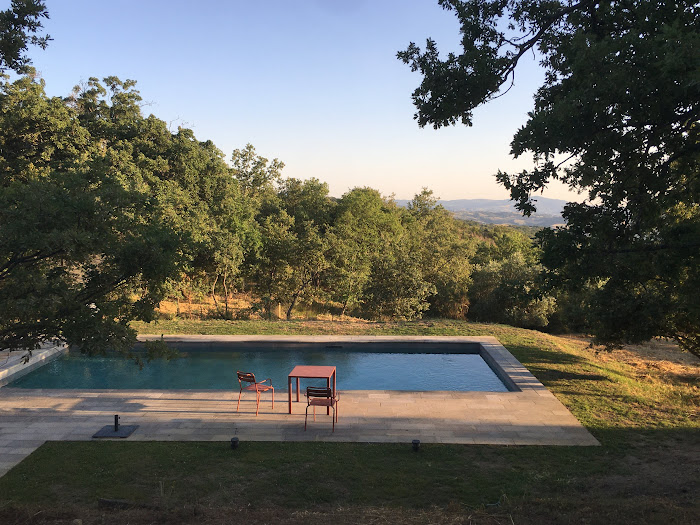
A beautiful early evening by the pool, in the resplendent Tuscan sun, time takes on a languid quality
|
|
Visia da Podere Santa Pia, fino al mare e Montecristo
|
 |
Reflections on the pool: Tuscan designs for swimming
|
 |
|
| |
|
|
|
|

Christopher Rothko, lecture “Mark Rothko and the inner world”, AGO, 2025.
Fra Angelico | Frescoes in the Convento di San Marco (1438-50)
|

[0] Photo Henry Elkan/Courtesy The Rothko Family Archive ©2026 by Kate Rothko Prizel and Christopher Rothko / Artist Rights
Society (ARS), New York / SIAE, Rome
[1] Rothko a Firenze, exhibition views, Palazzo Strozzi, Museo di San Marco, Biblioteca Medicea Laurenziana, Firenze, 2026. Photo Ela Bialkowska, OKNO Studio
[2] This article is based on the press release from Palazzo Strozzi | [Palazzo Strozzi, press area | www.palazzostrozzi.org/press-area]
|
| |
|
|
| |
|
|
|
| |
|
|
|
| |
|
|
|
| |
|
|
|
| |
|
|
|
| |
|
|
|